
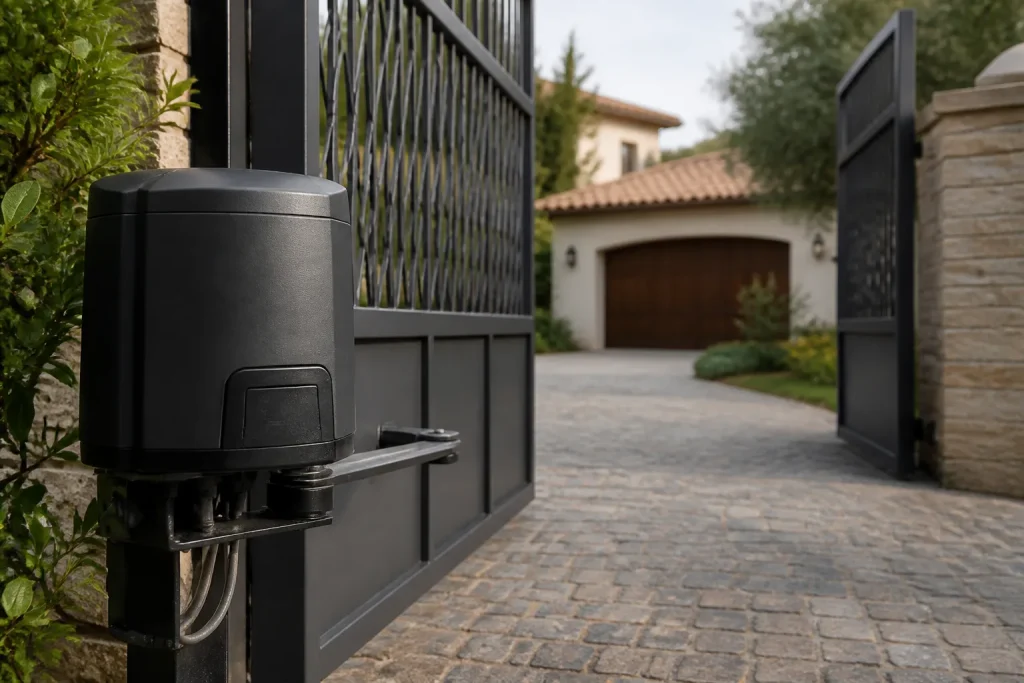
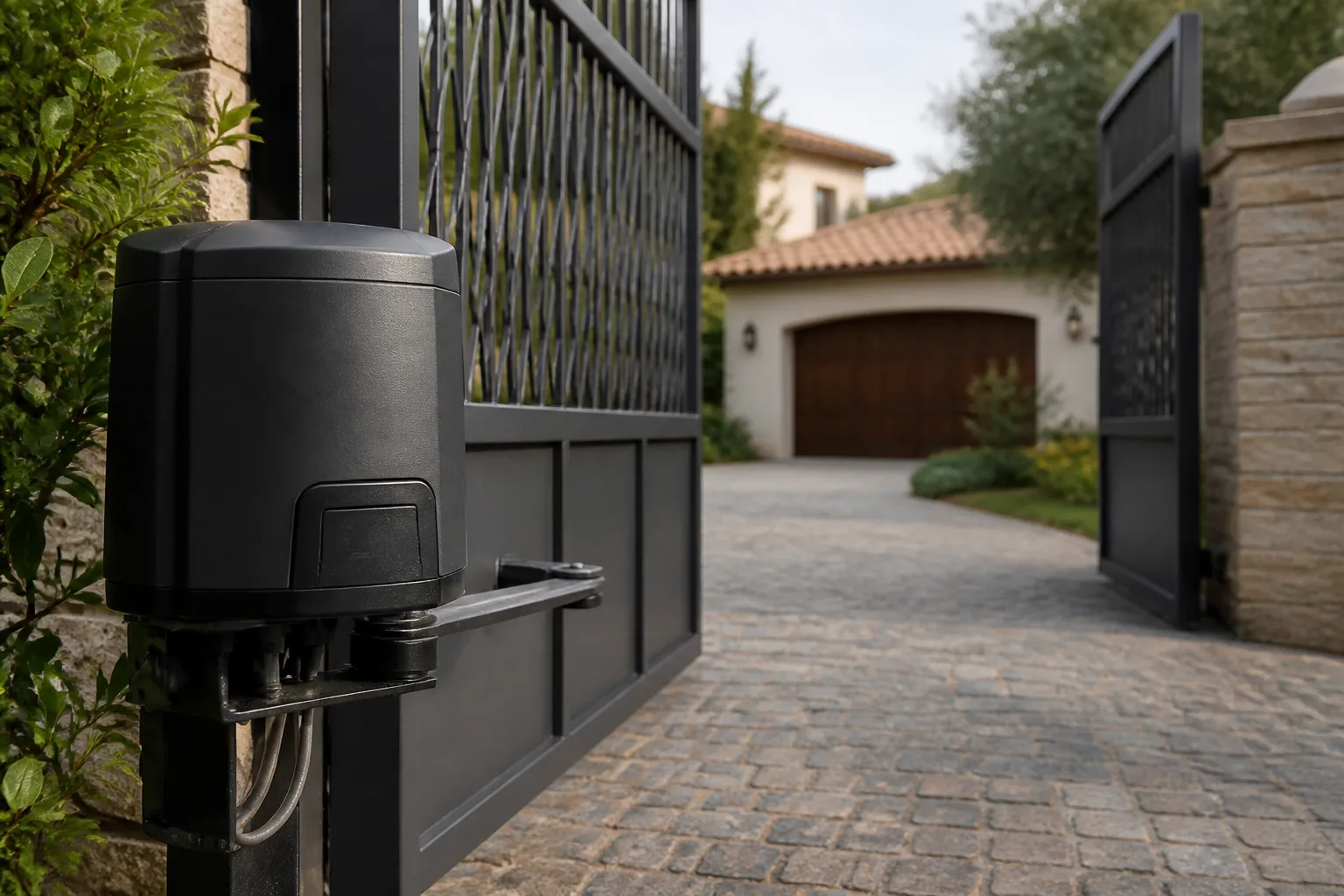
LiftMaster Gate Repair in Oxnard: A Homeowner’s Guide
If your LiftMaster gate stopped opening, halts partway, or triggers a reversing fault every afternoon around 4 p.m., you are almost certainly dealing with one of three things: the control board, a limit switch, or the safety reversing system. That covers the overwhelming majority of LiftMaster residential operator failures we diagnose in Oxnard, from the LA400 and LA500 to the CSL24V and RSL12V. Here’s the surprising part: the LA400 and LA500 use nearly identical control boards, and most repair guides treat them as separate products. Understanding what they share tells you exactly which parts are interchangeable in an emergency and which ones are proprietary and will add a week to your repair timeline.
If you’d rather skip the diagnosis and have someone who works on LiftMaster boards every week handle it, call (833) 589-9922 for a free estimate.
LiftMaster’s Residential Model Family: What Shares Parts and What Doesn’t
LiftMaster doesn’t make it obvious, but their residential gate operator line splits into two families. The LA400 (single swing), LA500 (dual swing), and LA500PKG variants share the same core control board architecture. The board, the transformer, and the limit switch assemblies are functionally interchangeable between these models. This is useful when you’re sourcing parts in Oxnard, because a board for an LA400 will usually run an LA500 with no modification.
The second family covers the slide operators: the SL3000, SL585, and RSL12V. These boards are not interchangeable with the swing-arm family. The SL585 and SL3000 share a harness layout, but the RSL12V uses a different DC motor controller entirely. If a technician tells you a board from one of these will drop into the other without rewiring, walk away. That’s not how these units are built.
The CSL24V sits in a strange middle ground. It’s marketed as a commercial slide operator, but plenty of Oxnard homes with long driveways use it. Its board shares the relay logic of the SL series but runs on 24V DC, not the 115V AC that the SL585 pulls. That voltage difference is the single most common reason we see a “simple board swap” turn into a cooked transformer.
Here’s the practical takeaway:
- LA400 / LA500 / LA500PKG: interchangeable control boards, limit switches, and transformers.
- SL3000 / SL585: interchangeable boards with minor harness differences; motors are model-specific.
- RSL12V: proprietary DC architecture; do not mix with SL series parts.
- CSL24V: commercial-grade DC unit; board shares logic with SL series but requires 24V transformer and battery backup unit.
This matters in Oxnard because parts availability varies. The Gate Repair in Oxnard calls we get about LiftMaster units often involve a homeowner who ordered a board online for the wrong subfamily and discovered the connector doesn’t fit. Name the exact model number on the arm or cover before you buy anything.
The Three Fault Patterns We See Most in Oxnard’s Coastal Climate
Oxnard’s salt air and sun do specific things to LiftMaster operators. Not theoretical things. Three patterns show up every single week on our service board.
1. Corrosion on the battery backup terminal. LiftMaster operators with battery backup (the LA500 with the 24V backup module, the CSL24V, and the RSL12V) all use a quick-disconnect terminal near the bottom of the enclosure. In coastal Oxnard, that terminal corrodes faster than any other connection in the system. The symptom: the gate runs fine on AC power but dies the moment PG&E blinks. The corrosion creates resistance that prevents the battery from charging, and the operator doesn’t flag a fault because the board’s self-diagnostic only checks battery presence, not battery health. You’ll see a green “battery connected” LED and still have a dead battery. We clean and re-terminate these connections regularly.
2. UV-degraded photo-eye alignment. The photo eyes on LiftMaster swing and slide operators sit in plastic housings that Oxnard’s sun breaks down over three to five years. The housing warps slightly, which changes the beam angle. The gate then reverses randomly, usually in the late afternoon when the sun hits the eyes at a low angle. Homeowners assume it’s a board failure because the fault is intermittent. It’s almost never the board. It’s the housing, and the fix is a $40 part plus realignment, not a $400 board replacement.
3. Salt-contaminated limit switch contacts. LiftMaster limit switches are mechanical micro-switches, not magnetic sensors like on newer Mighty Mule or Ghost Controls units. Salt air works its way into the switch body and corrodes the internal contacts. The switch still clicks, which makes homeowners think it’s working. But the board no longer reads the closure cleanly, so the gate over-travels and slams against the stop, or it stops six inches short of full open. The common Oxnard fix is replacing both limit switches and re-greasing the drive assembly, not a board replacement.
For comparison, we see these same corrosion patterns on other coastal installs like Electric Gate Repair in Oxnard work we do on FAAC and BFT units. The brand differs, but salt doesn’t care what name is on the cover.
MyQ Failures vs. Operator Failures: How to Tell the Difference in 10 Minutes
LiftMaster’s MyQ system creates a diagnostic problem that didn’t exist fifteen years ago. The gate won’t respond to the app, so the homeowner assumes the operator failed. In our experience, roughly half of all “MyQ gate not working” calls we get in Oxnard turn out to be a connectivity problem, not a motor problem.
Here’s how you tell the difference before you call anyone:
- Use the manual override key or the wall station. If the gate opens and closes from the physical controls on the operator, the motor, board, and limits are working. The problem is in the MyQ chain: the gateway, the home’s Wi-Fi, or the app itself.
- Check the MyQ gateway lights. The gateway is a separate module that supplies internet connection for operators. If the LED is off or blinking rapidly, the gateway lost its Wi-Fi connection. Unplug it, wait ten seconds, plug it back in. This fixes a surprising number of Oxnard calls.
- Check the app’s signal strength display. If the app shows “offline” for the gateway but your home Wi-Fi is fine, the gateway may have failed. A replacement gateway is cheaper than a service call, but only if you are certain the operator itself is physically fine.
- If physical controls don’t work either, then it’s likely the board, a limit switch, or the reversing system. This is when you want a technician who carries LiftMaster boards, not someone who will order one and come back next week.
We pulled a MyQ gateway out of a garage over in the Rio Lindo neighborhood of Oxnard last month where the homeowner had already ordered a new control board for a perfectly healthy LA500. The gateway had simply lost its IP address after a router swap. If he’d run the manual test, he’d have saved himself a few hundred dollars.
LiftMaster’s Warranty Structure for Gate Operators: What Coastal Homeowners Need to Know
LiftMaster’s gate operator warranty works differently from their garage door opener line, and very few Oxnard homeowners know the difference until they file a claim.
Most LiftMaster residential gate operators carry a five-year motor and gear box warranty, a two-year control board warranty, and a one-year accessory warranty covering photo eyes, keypads, and the receiver. That’s roughly comparable to what FAAC and BFT offer on their residential lines. But LiftMaster’s warranty has two exclusions that matter in coastal installations:
- Corrosion is not covered. Any visible salt corrosion on terminals, board connectors, or the chassis voids the warranty on that component. This is a standard exclusion across the industry, but LiftMaster enforces it strictly. A failed terminal with white powder around it will be denied.
- Improper surge protection voids the board warranty. LiftMaster requires that any gate operator installed in a lightning-prone area (which includes much of Oxnard’s flat, exposed terrain) have a surge suppressor on the incoming AC line. If a board fails from a power surge and there is no suppressor, the claim is denied.
This is practical information, not legal scare text. Before you buy parts or pay for a board swap, take a photo of the operator’s serial and model plate and check the installation date. If the unit is over five years old and shows coastal corrosion, a board replacement may cost about the same as the remaining useful life of the operator. That leads to the next question.
When a LiftMaster Board Replacement Makes Sense, and When Full Replacement Is Cheaper
The control board is the most expensive common replacement part in a LiftMaster operator. Depending on the model, an LA500 board runs roughly $300 to $450. A CSL24V board can run higher. Add installation, and you’re looking at a meaningful repair bill on a unit that may be six or seven years old.
This is the math we walk Oxnard homeowners through when a board dies:
- Unit age under five years, no visible corrosion: replace the board. The motor and gearbox likely have five-plus years left. The repair is worth it.
- Unit age five to eight years, some terminal corrosion: the board may be fixable with terminal re-termination and cleaning. If the board itself is dead, replacement is defensible if the rest of the unit is clean. But get a written quote before diving in; you’re near the break-even point.
- Unit age over eight years, heavy corrosion, original motor: put the board money toward a new operator. The motor is close to end of life regardless of the board, and you’ll be paying for another repair in twelve to eighteen months. In coastal Oxnard, an eight-year-old operator with salt exposure is not a repair candidate; it is a replacement candidate.
This same rule applies to other brands we service. An Elite or FAAC unit with the same age and corrosion profile gets the same recommendation. The brand doesn’t change the economics. The condition does.
If you are weighing a repair against a new unit, a Gate Installation in Oxnard consultation will give you straight numbers on both options before you commit to either.
The Bottom Line
LiftMaster gate repair in Oxnard comes down to knowing your model family, checking the three coastal fault patterns before assuming a board failure, and separating MyQ connectivity issues from actual operator problems. The LA400 and LA500 share boards; the slide operators don’t. Corrosion on battery terminals, UV-warped photo-eye housings, and salt-contaminated limit switches account for the majority of what we fix on LiftMaster units in this area. And if the operator is over eight years old with visible salt damage, a board replacement is usually a short-term fix on a long-term problem.
If you’re in Oxnard and your LiftMaster gate is misbehaving, Gate Repair Oxnard offers free estimates over the phone. We work on LiftMaster along with FAAC, BFT, Elite, Linear, Viking, Ghost Controls, DoorKing, and Mighty Mule, from swing gates to slide gates to barrier arms. Call (833) 589-9922 and tell us the model number; we’ll tell you exactly what we think is wrong and what it costs before anyone shows up.
Frequently Asked Questions
How much does LiftMaster gate repair cost in Oxnard?
Most LiftMaster gate repairs in Oxnard run between $150 and $450, depending on whether the problem is a limit switch, photo-eye housing, or control board. A board replacement on an LA400 or LA500 typically lands in the $350 to $500 range installed. Slide operator boards like the SL585 or RSL12V can run higher. Every quote is agreed before work starts. Call (833) 589-9922 for an exact number on your model.
Can you fix a LiftMaster gate the same day?
Usually, yes. Most LiftMaster swing and slide operator repairs use parts we keep in stock, including LA400/LA500 boards, limit switches, and photo-eye kits. If your unit needs a slide-operator motor or a proprietary RSL12V component, we may need to order it. We’ll tell you before you commit.
Why does my LiftMaster gate reverse for no reason?
In Oxnard, the two most common causes are UV-warped photo-eye housings and salt-contaminated limit switch contacts. The photo-eye issue shows up most in late afternoon when sun hits the eyes at a low angle. The limit-switch issue causes over-travel or early stops. Neither requires a board replacement in most cases.
Is LiftMaster still the best choice for an Oxnard gate operator replacement?
LiftMaster makes a solid residential operator, especially the LA500 for dual swing gates. But for coastal Oxnard installation, we also recommend considering FAAC and BFT for their sealed enclosure designs, or Elite for slide gates. The right choice depends on gate weight, opening, and exposure. We’ll give you an honest recommendation based on your specific setup, not a brand deal.
Written by the team at Gate Repair Oxnard, serving Oxnard since 2017.
Need Gate Repair Help?
Call Gate Repair Oxnard - licensed & insured, here with fast help in Oxnard.
(833) 589-9922