
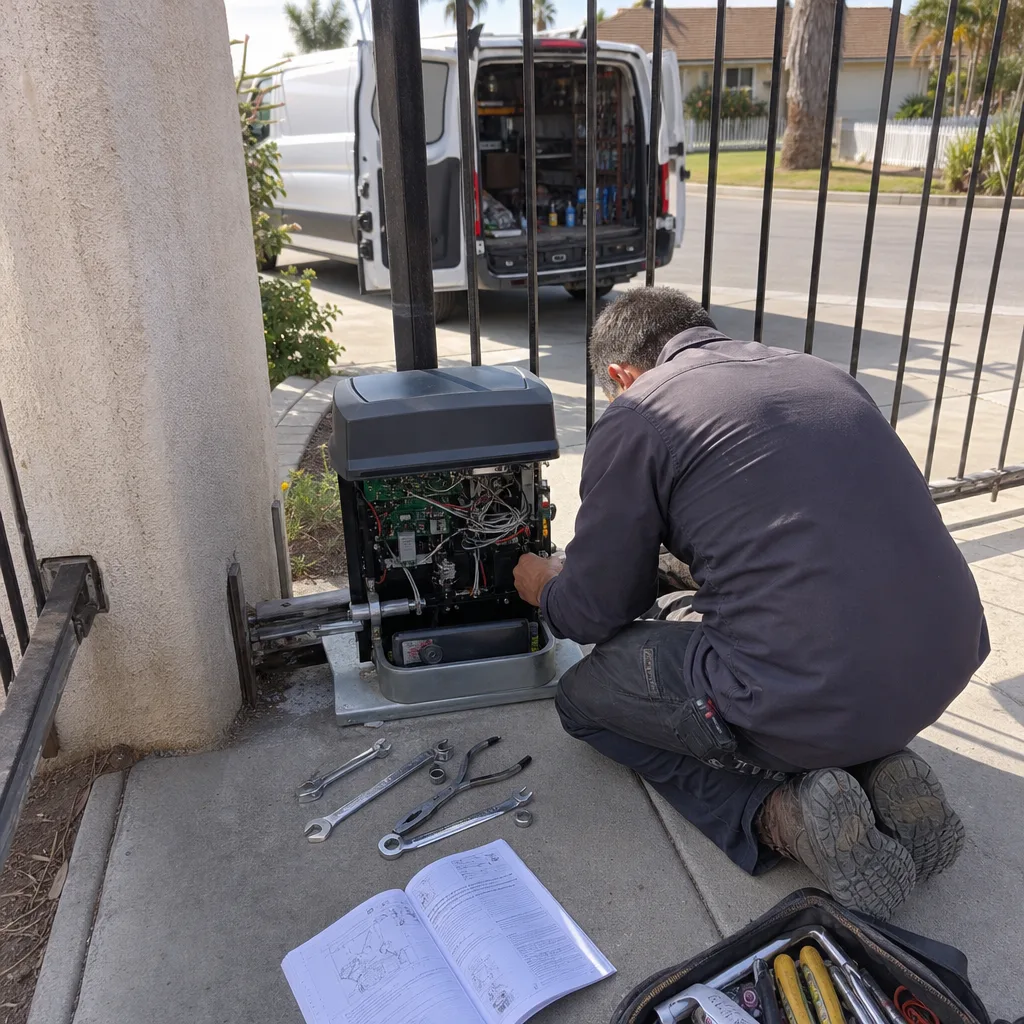
Last updated November 2, 2026
 Wrought iron
 Wood & steel frame
 Farm & ranch
 Sliding driveway gates
 LiftMaster operators
Free on-site gate assessment - hinges, posts, and your LiftMaster or Nice gate operator checked before anything is quoted
The assessment is free and the quote is the invoice.
Get your free estimateGate Repair Permits, Codes & Inspections in CA: What You Need to Know
A homeowner replaces a swing gate operator on a Saturday afternoon. The motor mounts cleanly, the remote pairs on the first try, and the gate opens and closes without a hitch. What that homeowner doesn’t realize is the job is already out of code compliance. The moment a new operator is installed without updating the entrapment protection devices to match, the property carries a liability exposure that no inspection sticker will cover. This guide walks through what actually triggers a permit, what UL 325 requires, what inspectors look for in Oxnard and Ventura County, and where HOAs fit into the chain of authority. For Gate Repair Warning Signs: An Oxnard Homeowner’s Reference Guide and more, see our resources. You’ll learn when a repair is just a repair, when it becomes an alteration, and how to avoid the compliance gaps that come back years later in a lawsuit.
Quick Answer
Most our Gate Repair services in California do not require a building permit. Replacing a hinge, a wheel, a keypad, or a photo eye on an existing gate is maintenance. But when the repair involves replacing a gate operator, adding entrapment protection, running new electrical, or altering the gate’s structure, permit and inspection requirements kick in under California Building Code and the local amendments adopted by Ventura County and the City of Oxnard. UL 325 compliance is mandatory for any automated gate system regardless of whether a permit was pulled, and it is the standard that creates the most liability exposure for property owners.
Styles & brands we work with
- Wrought iron
- Wood & steel frame
- Farm & ranch
- Sliding driveway gates
- LiftMaster operators
Table of Contents
- When a Gate Repair Is Just Maintenance (No Permit Required)
- When a Gate Repair Triggers a Permit in California
- UL 325 and Entrapment Protection: The Code Every Operator Must Meet
- Ventura County and City of Oxnard Thresholds: Repair vs. Alteration
- HOA Gate Regulations: Who Has Jurisdiction and in What Order
- What a Gate Inspector Looks For in Oxnard
- Liability Exposure for Property Managers After a Non-Compliant Repair
- Code Compliance Checklist for Gate Repairs in California
When a Gate Repair Is Just Maintenance (No Permit Required)
California Building Code draws a line between maintenance and alteration, and that line matters. Maintenance means restoring a component to its original designed condition without changing the system’s function, capacity, or safety profile. In practice, a property owner in Oxnard can replace a rusty gate hinge, swap out a bent track wheel, re-weld a cracked weld on a slide gate frame, or install a new keypad without involving the building department. None of these activities change how the gate operates or how it protects against entrapment.
Here are the repairs that fall squarely in the maintenance category across most of Ventura County:
- Replacing gate hinges, brackets, or rollers on a swing or slide gate
- Lubricating and adjusting existing hardware without disassembly
- Replacing a keypad, remote receiver, or loop detector wired to an existing operator
- Replacing a photo eye or edge sensor with a direct equivalent part
- Adjusting the open and close limits on an existing operator
- Replacing gate wheels, guide rollers, or track sections that have worn out
- Repainting or refinishing a gate without structural modification
That said, even maintenance work must not leave a gate in a less-safe condition than it was before. A replacement photo eye must be installed at the correct height and angle. A replacement hinge must match the load rating of the original. If a repair changes the gate’s weight, balance, or closing force, it may drift from maintenance into alteration territory, which is where permits enter the picture.
When a Gate Repair Triggers a Permit in California
Permit triggers for gate systems are governed by the California Building Code (CBC), the California Electrical Code (CEC), and local amendments. The most common trigger is an operator replacement, and the reason is not the motor itself. It is the electrical work and the safety system associated with it. Installing a new gate operator means connecting line voltage to a new device, which is electrical work under the CEC. Even a 24-volt DC operator conversion can require a permit if it involves new wiring, a new transformer, or a new disconnect.
Here are the specific scenarios that require a permit in Oxnard and unincorporated Ventura County:
- Replacing a gate operator with a different model or brand. The newer operator may have different entrapment protection requirements. The old system’s photo eyes and edge sensors may not be compatible. A permit ensures the new installation meets current UL 325 standards, not the standards from when the old operator was installed.
- Adding a new gate operator to a gate that was previously manual. This is an alteration, not a repair. It changes the gate from a passive barrier to an automated machine with entrapment risk. The California Building Code treats this as new work.
- Installing new entrapment protection devices. Adding photo eyes, edge sensors, or contact strips to an existing automated gate typically requires an electrical permit because these devices are low-voltage or line-voltage connected.
- Running new electrical service to a gate. Any new conduit, wire, or disconnect from a panel to a gate operator is electrical work that requires a permit and an inspection, both in the City of Oxnard and Ventura County.
- Modifying the gate’s structural design. Widening an opening, changing a swing gate to a slide gate, extending the gate leaf, or adding weight to a gate leaf changes the operator’s load profile and the safety calculations. These are alterations under CBC Chapter 1, not repairs.
- Installing a vehicle loop detector or access control system wired to an operator. When the access control system interacts with the gate’s open and close logic, the wiring and the safety integration require a permit.
One point that surprises property owners: replacing a gate operator with the exact same make and model in the exact same footprint still technically involves electrical disconnection and reconnection, and the safest path is to call the Oxnard building department and ask. Some inspectors will classify a direct swap as maintenance. Others will want to see a permit because the operator is a safety device. We’ve never seen a property owner regret asking. We have seen property owners regret guessing.
UL 325 and Entrapment Protection: The Code Every Operator Must Meet
UL 325 is the ANSI/UL standard that governs the safety of automatic gate operators and access control systems. It applies in all 50 states, and California enforces it through the CBC, the CEC, and the state’s Health and Safety Code. The standard addresses four types of entrapment: pinch points, crush points, shear points, and pull points. The core mechanism for protection is a pair of independent device types: a primary inherent entrapment protection system (the operator’s built-in reversing mechanism) and a secondary external entrapment protection device, typically a photo eye or an edge sensor.
When a gate repair involves replacing or modifying an operator, the new configuration must meet the UL 325 entrapment protection requirements that were in effect when the new operator was manufactured. A FAAC operator installed new in 2024 has different sensing requirements than a Linear operator from 2008. The moment a technician installs that 2024 FAAC unit, the entrapment protection must be brought up to the 2024 standard for the entire gate system, not just the operator itself.
The main entrapment protection requirements that apply to every automated gate in Oxnard:
- Primary inherent entrapment protection: The operator must have an internal sensing mechanism that detects an obstruction and reverses direction. For a swing gate, this is a current-sensing circuit that monitors motor load. For a slide gate, it may be a current sensor or a speed sensor. The reverse function must operate without external devices.
- Secondary external entrapment protection: At least one non-contact sensor (photo eye) or contact sensor (edge strip) must be installed at each entrapment zone. On a swing gate, the entrapment zones include the hinge side, the latch side, and the leading edge. On a slide gate, the zones include the leading edge, the trailing edge, and the area between the gate and the fence or wall.
- Monitoring requirement: The external entrapment protection device must be monitored by the operator. If the photo eye or edge sensor fails or is disconnected, the operator must not run in the automatic mode. A monitored device sends a signal to the operator indicating it is present and functional. Unmonitored devices are not acceptable for new installations.
- Auto-reverse function: When the gate encounters an obstruction, it must reverse within two seconds. The reverse force must not exceed the UL 325 maximum force limit for the gate type. Force limits vary by gate type and gate weight.
- Warning signage: All automated gates must display warning signs that identify the gate as an automatic gate system and warn against pedestrian use of a vehicle gate. Signs must be visible from both sides of the gate.
Here is the compliance gap that catches property owners in Oxnard: a homeowner replaces a dead Mighty Mule or Ghost Controls unit with a used operator bought from an online marketplace. The old operator had a working photo eye but it was unmonitored. The new operator is a different brand, perhaps a Viking or BFT unit, and its control board requires a monitored device. The homeowner plugs in the old photo eye, wires it up, and the gate works. But the system is non-compliant because the unmonitored device does not meet the new operator’s UL 325 listing. Every time that gate opens, it is operating outside code. If a child triggers the gate and is injured, the homeowner’s defense is “the gate worked.” That defense does not survive a UL 325 analysis.
Ventura County and City of Oxnard Thresholds: Repair vs. Alteration
The City of Oxnard and Ventura County both adopt the California Building Code with local amendments. The distinction between repair and alteration is defined in CBC Chapter 1, Section 105, and the local amendments do not soften that distinction for gate systems. Oxnard’s building department follows the same permit thresholds, but the practical enforcement differs depending on whether the property is in the incorporated city or in unincorporated county territory like El Rio, Nyeland Acres, or the agricultural parcels east of Oxnard.
In the City of Oxnard, a gate operator replacement that involves new electrical wiring is treated as an electrical alteration. The permit is issued by the Oxnard Building Division, and the electrical inspection is performed by the city’s electrical inspector. The permit cost for a simple operator replacement is modest, typically in the low hundreds of dollars, but the inspection is the valuable part. An inspector confirms the operator is listed for the gate type and gate weight, verifies the entrapment protection devices are present and monitored, and tests the auto-reverse function. That inspection record is the property owner’s best protection against a future liability claim.
In unincorporated Ventura County, the Ventura County Building and Safety Division handles the same work. The thresholds are identical. The difference is responsiveness. County inspectors cover a much larger territory than city inspectors, and a permit that clears in a few days in the city can take a week or longer in unincorporated areas. That timeline matters when a gate is securing a commercial property or a multi-tenant site.
The practical threshold for both jurisdictions is this: if the work changes what the gate is or how it functions, treat it as an alteration. If the work restores what was already there, treat it as maintenance. When we replace a failed gate operator in Oxnard, we treat the job as an alteration for the purpose of UL 325 compliance regardless of whether the customer pulls a permit. The inspection is separate from the compliance. They are two different obligations.
HOA Gate Regulations: Who Has Jurisdiction and in What Order
Oxnard has dozens of gated communities and HOA-governed neighborhoods, and the HOAs add a regulatory layer that runs parallel to municipal code. The chain of authority matters: HOA rules do not override building code, and building code does not override state law. The order of precedence is California state law, then the California Building Code and California Electrical Code, then Ventura County or City of Oxnard amendments, then the HOA’s CC&Rs and architectural guidelines.
What an HOA can and cannot require on a gate repair in Oxnard:
- An HOA can require architectural approval for any gate that is visible from the street or from a common area. Even a repair that replaces a gate panel with a different material, color, or design can require HOA approval, even if it requires no building permit.
- An HOA cannot require a homeowner to violate building code. If an HOA architectural guideline prohibits a particular safety device or requires a gate configuration that does not meet UL 325, the building code wins. The HOA must amend its guideline.
- An HOA can require a specific gate operator brand for aesthetic or access-control consistency. Many Oxnard HOAs standardize on a specific brand, often LiftMaster or DoorKing, because the HOA’s property manager maintains the common-area access control system. A homeowner who replaces an operator must match the brand the HOA requires, even if the old operator was a different brand.
- An HOA can require a permit even when the city does not. Some Oxnard HOAs require a copy of a building permit or a licensed contractor’s invoice before approving any gate work visible from the street.
- An HOA has enforcement power over common-area gates, not just private gates. If the gate is on common property, the HOA board is responsible for code compliance, inspection records, and the operator maintenance log. The liability for a common-area gate injury falls on the HOA, not the individual homeowner.
The order to follow on a gated property in Oxnard: check the CC&Rs first, submit an architectural request if required, then determine if the work needs a city or county permit, then complete the work with UL 325 compliance, then keep the inspection record. This sequence prevents the scenario where a homeowner pays for a repair, then the HOA demands a tear-out because the new gate panel is not the approved color.
What a Gate Inspector Looks For in Oxnard
When an Oxnard building inspector arrives for a gate inspection, the inspection focuses on entrapment protection and electrical safety, not on whether the gate opens smoothly. Gate inspections are roughly 30 minutes, and the inspector will typically run through a standard checklist. Knowing that checklist before the inspection prevents a failed inspection and the re-inspection fee that comes with it.
Here is what we have seen Oxnard and Ventura County inspectors check on a gate system, in order:
- Operator listing and gate compatibility. The inspector verifies the operator is listed for the gate type (swing, slide, barrier) and the gate weight. If the operator is a BFT unit rated for 800 pounds and the gate leaf weighs 1,100 pounds, that is a fail. The listing information is on the operator’s data plate.
- Primary entrapment protection. The inspector tests the operator’s inherent reversing mechanism. This usually means placing a test object or applying manual resistance to the gate while it is closing and confirming the gate reverses within two seconds.
- Secondary entrapment protection. The inspector checks that photo eyes or edge sensors are present at every entrapment zone. On a slide gate, this includes the leading edge and the trailing edge. On a swing gate, this includes the hinge zone and the latch zone. The inspector verifies the devices are monitored, which can be confirmed by disconnecting a sensor and observing whether the operator refuses to run in automatic mode.
- Force limit testing. Using a force gauge, the inspector may measure the maximum force the gate applies at the closing edge. The force must remain below the UL 325 limit for the gate’s classification.
- Electrical grounding and bonding. The inspector checks the operator’s ground connection, the disconnect location, and the conduit installation. Exposed wiring, missing grounds, and undersized conductors are the most common electrical failures on gate installations in Oxnard.
- Warning signage. The inspector verifies the UL 325 warning sign is present on both sides of a vehicle gate. A missing sign is a minor correction, but it is still a correction.
- Pedestrian separation. If the vehicle gate is the only access point, the inspector will check that a separate pedestrian gate exists or that the vehicle gate is designed to allow pedestrian passage with proper entrapment protection. A vehicle gate used as the only pedestrian path is a serious safety concern and a common fail point.
The inspection record matters. A passed inspection creates a paper trail that confirms the gate system met the UL 325 standard and the California Electrical Code on the inspection date. For a property manager, that paper trail is the first line of defense in a liability claim. For a homeowner, it is proof that the repair or installation was done to code. It is not a guarantee against future failure, but it moves the liability from “the owner was negligent” to “the owner did what the code required.”
Liability Exposure for Property Managers After a Non-Compliant Repair
Property managers in Oxnard carry a different liability profile than homeowners. A homeowner who makes a code mistake on their own gate has personal exposure. A property manager who arranges or approves a non-compliant repair has professional exposure, and it extends to the property owner, the management company, and in some cases the individual manager. California case law on premises liability treats automatic gates as a known hazard class, and entrapment injuries involving children produce significant settlements and verdicts.
The exposure comes from three directions. First, an injured party can claim the property manager knew or should have known the gate was non-compliant after a repair. Second, an insurance carrier can deny coverage on the grounds that the property owner failed to maintain the gate system to code, leaving the property owner and the manager personally exposed. Third, Cal/OSHA and HOA liability statutes create a record-keeping obligation for common-area gates that makes a missing inspection report a discovery problem during litigation.
For a property manager, the protective sequence is: pull the permit when the work triggers one, use a contractor who documents UL 325 compliance on every repair, retain the inspection record, and keep a maintenance log for the gate system. A gate maintenance log that shows regular service, documented entrapment protection testing, and timely repair of any failed safety device is evidence that the property was managed responsibly. The absence of that log is evidence the other side’s attorney will use.
We have worked on commercial gate systems in Oxnard where the entrapment protection had been disconnected for years. The property manager inherited the problem. When the gate failed and we were called out, the repair required not just a new edge sensor but a full compliance update because the operator had been running unmonitored. The cost of the compliance update was several times the cost of a timely sensor replacement. Deferred gate maintenance compounds fast.
Code Compliance Checklist for Gate Repairs in California
Here is the checklist we use when we evaluate a gate system in Oxnard. It covers the California Building Code, the California Electrical Code, UL 325, and the local requirements in Ventura County and the City of Oxnard. Property owners and managers can use this list to check their own gates before calling for service or before a city inspection.
- Confirm the gate type and operator compatibility. Swing, slide, or barrier. Operator rated for the gate’s weight and cycle count.
- Confirm primary entrapment protection is functional. Test the auto-reverse by blocking the gate’s path with an object that will not damage the gate. The gate must reverse within two seconds.
- Confirm secondary entrapment protection exists at every entrapment zone. Swing gates need hinge-side and latch-side protection. Slide gates need leading-edge and trailing-edge protection.
- Confirm entrapment protection devices are monitored. Disconnect a photo eye or edge sensor and try to run the gate. If it runs in automatic mode, the device is unmonitored and the system is non-compliant.
- Confirm warning signage is present and legible on both sides of the gate.
- Confirm the electrical installation meets current code. Grounded, proper disconnect, conduit intact, no exposed splices.
- Confirm the gate’s closing force is within UL 325 limits for the gate’s classification.
- Confirm any new operator installation has a permit and passed inspection, if required.
- Keep a maintenance log. Note dates, work performed, parts replaced, and entrapment protection test results.
When a Repair Becomes an Alteration: The Oxnard-Specific Triggers
Oxnard’s coastal climate creates gate failure modes that inland cities rarely see. Salt air corrodes gate hinges and operator enclosures faster. Marine layer moisture accelerates rust on steel gates and degrades the seals on photo eyes and edge sensors. These environmental factors mean that an Oxnard gate repair is more likely to involve replacement of corroded structural components than the equivalent repair in, say, Bakersfield or Fresno.
The trigger point is whether the replacement changes the gate’s structural behavior. Replacing a rusted hinge with an identical hinge is maintenance. Replacing a rusted steel gate leaf with an aluminum leaf of the same dimensions but different weight is an alteration, because the lighter leaf changes the operator’s load profile and the entrapment protection calculation. The inspector’s concern is not the hinge or the leaf itself. It is the chain of consequences.
We see this in Oxnard’s older neighborhoods, where original gates were built from heavy steel and the operators were installed in the 1990s or early 2000s. When the steel gate finally rusts through and the owner replaces it with a modern aluminum gate, the old Linear or Viking operator may now be oversized for the gate. That is not a problem on its own. The problem is that the old entrapment protection was tuned to the old weight and closing force. The new gate is lighter, closes faster, and the old force settings may exceed the current UL 325 limit for the new gate configuration. A repair that looked simple at the outset has become an alteration requiring a compliance update.
For more on how we diagnose these situations, see our Gate Repair in Oxnard page. For issues specific to powered systems, Electric Gate Repair in Oxnard covers operator diagnostics and entrapment protection in depth.
Common Mistakes to Avoid
- Skipping the permit on an operator replacement. A new operator is not just a motor swap. It is an electrical installation and a safety-system alteration. The permit and inspection record is the only proof the new system meets code. In Oxnard, a failed inspection on unpermitted work is a more expensive correction than pulling the permit from the start.
- Reusing old entrapment protection devices with a new operator. The old photo eye may not be monitored, may not be the correct voltage, or may not communicate with the new control board. A new FAAC or BFT operator paired with a 15-year-old sensor is a compliance failure waiting to be discovered.
- Installing an operator that is not rated for the gate’s weight. This is the most common cause of premature operator failure and entrapment risk. A homeowner replaces a 600-pound gate with an operator rated for 400 pounds because the motor was cheaper. The motor works until the gate binds, and then it does not reverse properly.
- Ignoring HOA rules until after the work is done. In some Oxnard communities, the HOA will require removal of a gate that was repaired with a non-approved color or material. The cost of redoing the work exceeds the cost of the original repair.
- Disconnecting entrapment protection to stop false reversals. When a photo eye triggers false reversals, the problem is usually alignment, wiring, or a failing sensor, not the safety device itself. Disconnecting the device makes the gate operate without secondary entrapment protection, which is a code violation and a liability exposure.
- Treating a manual gate conversion as a simple operator installation. Adding an operator to a gate that was never automated changes the gate from a passive structure to a machine. The conversion triggers entrapment protection requirements, signing requirements, and a permit. Skipping these steps leaves the property owner fully exposed if an injury occurs.
See the difference
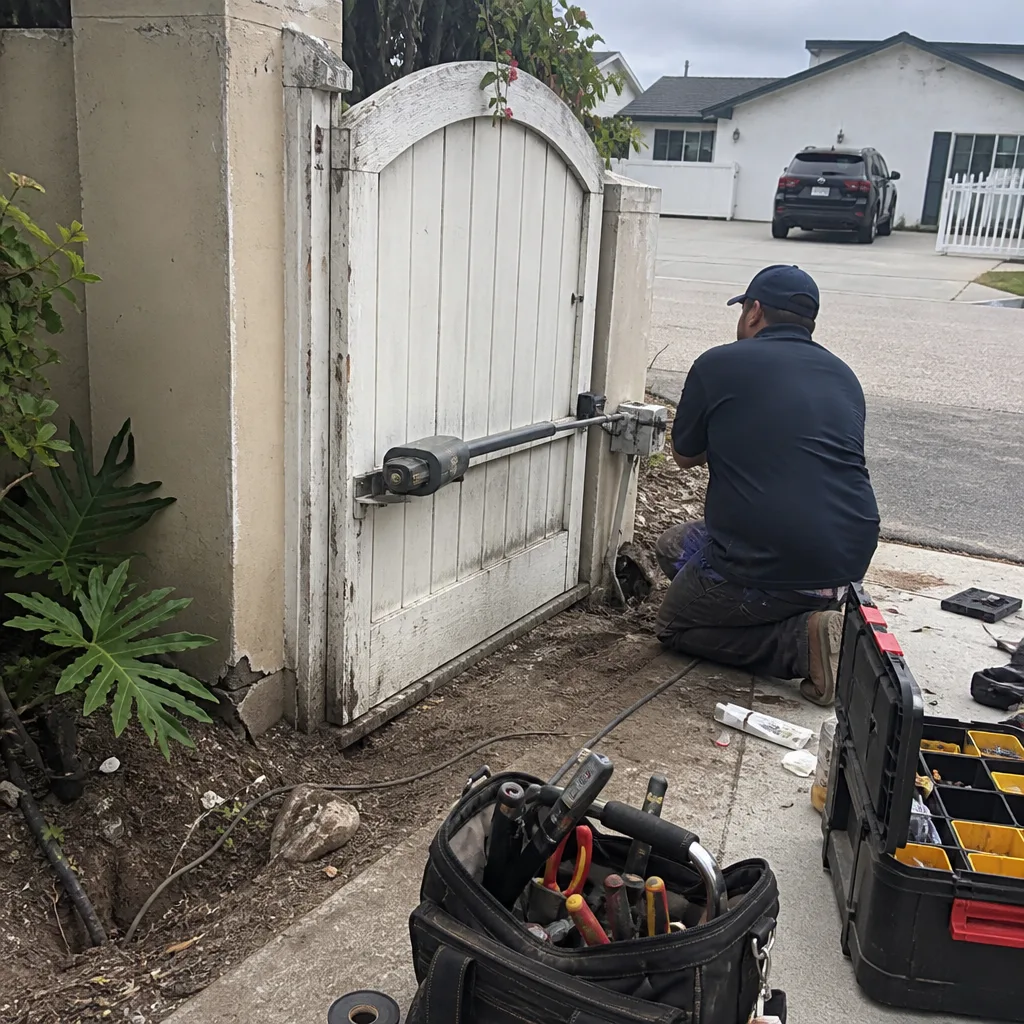 Before
 After
 Before
 After
 Before
 After
When to Call a Professional
Call a professional when the repair involves an operator replacement, new electrical work, entrapment protection installation, or any change to the gate’s structure. These are the jobs where code compliance matters and where a mistake carries liability that stretches years into the future. Also call when the gate fails an entrapment protection test, when the auto-reverse does not work, or when an inspector has flagged a violation. Those are not comfort calls. They are correction calls, and the clock is running.
Gate Repair Oxnard works on gate systems across Oxnard and Ventura County, from single-family swing gates to commercial slide gates and access control systems. We work on LiftMaster, FAAC, BFT, Linear, Viking, Ghost Controls, DoorKing, Elite, and Mighty Mule equipment. If you’re unsure whether your gate repair needs a permit, call us at (833) 589-9922 and describe the job. We’ll tell you honestly whether it is maintenance or an alteration. Estimates are free, and the answer is free either way.
Frequently Asked Questions
In most cases, yes. Replacing a gate operator is electrical work under the California Electrical Code, and the City of Oxnard requires a permit for new electrical installations and alterations. A direct swap of the exact same operator model may be treated as maintenance, but the safest path is to call the Oxnard Building Division and ask. Call (833) 589-9922 and we can tell you which category your job falls into before you file.
UL 325 is the safety standard that governs automatic gate operators, including entrapment protection, force limits, and warning signage. It applies to every automated gate in California regardless of whether the gate was permitted. If your gate has an operator, it must meet UL 325. A gate that does not meet the standard exposes the property owner to liability every time the gate cycles.
Yes. HOAs in Oxnard can require a specific operator brand for aesthetic or access-control consistency, especially in communities with common-area gate systems. The HOA cannot require you to violate building code, but it can require brand consistency. Check your CC&Rs before purchasing a replacement operator.
A gate inspector in Oxnard checks operator compatibility, primary and secondary entrapment protection, monitoring status, force limits, electrical grounding, warning signage, and pedestrian separation. The inspection usually takes about 30 minutes. A failure on any entrapment protection item means a correction and a re-inspection.
Gate permit costs in Oxnard vary by project scope, but a simple operator replacement with electrical work typically falls in the low hundreds of dollars. The permit fee is small compared to the liability of an unpermitted installation. Call the Oxnard Building Division for a current fee schedule, or call (833) 589-9922 and we can give you a realistic estimate of the full repair cost including any permit fees.
The property owner faces a premises liability claim, and the absence of a permit and inspection record becomes evidence of negligence. Insurance coverage may also be compromised if the carrier determines the gate system was not maintained to code. The permit and inspection record is the owner’s protection. Without it, the liability picture is much worse.
New Gate Installation vs. Repair: The Permitting Difference
New gate installation in Oxnard is a different permit class than gate repair. A new gate on a new property or a new gate line on an existing property requires a building permit for the structure, an electrical permit for the operator wiring, and often a planning or zoning clearance if the gate is on a property line, in a front setback, or adjacent to a public right-of-way. The permitting path for a new installation is longer, the fees are higher, and the inspection is more thorough. If you’re planning a new gate, start with the permit process. Do not reverse-engineer it after the gate is in.
For a full breakdown of what a new installation involves in Oxnard, see our Gate Installation in Oxnard page. And if you’re still deciding between repairing an existing system and replacing it, start with Gate Repair Oxnard home for the overview.
The Bottom Line
Most gate repairs in California don’t need a permit. But the repairs that matter, operator replacements, electrical work, structural alterations, and anything involving entrapment protection, all carry code and permit obligations that property owners in Oxnard overlook at their own risk. UL 325 is the standard that governs every automated gate, and the liability exposure for a non-compliant system is real and enduring. A permit and an inspection record are not bureaucratic formalities. They are the difference between a gate that works and a gate that is defensible. When the repair crosses from maintenance into alteration, pull the permit, do the compliance work, and keep the paper. The inspector’s signature is the cheapest liability insurance a property owner will ever buy.
Written by the team at Gate Repair Oxnard, serving Oxnard since 2017.